Police Encounters (Stanford Studies in Middle Eastern and Islamic Societies and Cultures) by Ilana Feldman
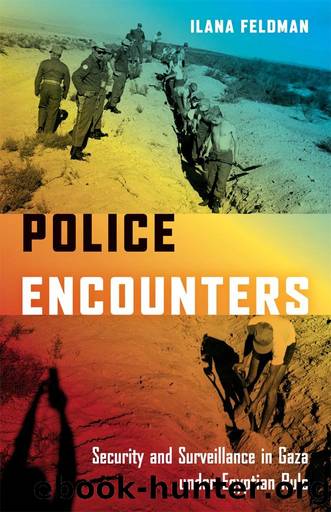
Author:Ilana Feldman [Feldman, Ilana]
Language: eng
Format: mobi
Publisher: Stanford University Press
Published: 2015-05-12T22:00:00+00:00
5
Peacekeeping and International Community
IN THE SECOND HALF OF THE EGYPTIAN ADMINISTRATION âafter the pullback of Israeli occupation forces in March 1957âEgyptian and Palestinian security personnel were joined by a new international peacekeeping force: the United Nations Emergency Force (UNEF). The presence of this force highlights the significant international concern with security matters in Gaza, the range of actors involved in policing this space, and the array of security problems identified in this practice. In turning to the work of UNEF, this chapter brings a different set of actors into the consideration of the security landscape in Gaza. The UNEF experience is a reminder that security society in Gaza was not produced only in negotiations between Palestinians and Egyptians. The space was always connected to an international and a regional field whose actors mattered at the local level. In UNEFâs work we encounter these actors operating on the ground. The issues that loomed largest in Egyptian security practiceâthreats to national interest and to social proprietyâcontinued to matter in UNEF practice (though not always in the same ways), and they were joined by additional concerns about threats to the full establishment of a robust âinternational community.â
The previous chapter explored intersections between citizenship and security in Gazaâs security society. UNEFâs work in Gaza indicates how population and security came together in this field and, especially, highlights the crucial presence of the additional category of âhumanity.â Whereas Gazans made claims to Egyptian administrators as Palestinian citizens and as Arabs, when they were disappointed in their treatment by UNEF, they often used the language of âhumanityâ to express frustration and make demands for better treatment. UNEF soldiers and officials sometimes took up this language in their responses, but even more frequently they interacted with Gazans (when they interacted with Gazans) through the prism of population or security threat. Not only did UNEF soldiers take an interest in providing charitable aid to locals, approaching them as subjects in need and deserving of compassion; their descriptions of them as security threats (as when they crossed the border or got into conflict with UNEF forces) suggests a view of Gazans as, variously, an uncontrolled mob, a local culture group, and even primitives.
Whether seen as humanity, as population, or as threat, UNEFâs interest in and ability to respond to Gazan demands was sometimes limited both by the structure of the force and by the perceived security problems that undergirded its practice. Where Egyptian administrators sought to control independent Palestinian political and military activity in the service of the national interest, UNEF personnel sought this same kind of control (insofar as such activity pertained to the border) in the name of regional stability. Containing the threat of military activity across the armistice line was the heart of the forceâs mission. Worries about social propriety were also key to UNEFâs practice, but not because promoting propriety was part of their mission, as Egyptian officials might have argued it was part of theirs, but because violations of proper behavior could undermine the capacity of the force to pursue its aims of maintaining âinternational peace and security.
Download
This site does not store any files on its server. We only index and link to content provided by other sites. Please contact the content providers to delete copyright contents if any and email us, we'll remove relevant links or contents immediately.
| Anthropology | Archaeology |
| Philosophy | Politics & Government |
| Social Sciences | Sociology |
| Women's Studies |
Cecilia; Or, Memoirs of an Heiress — Volume 1 by Fanny Burney(32558)
The Great Music City by Andrea Baker(32019)
Cecilia; Or, Memoirs of an Heiress — Volume 2 by Fanny Burney(31956)
Cecilia; Or, Memoirs of an Heiress — Volume 3 by Fanny Burney(31942)
We're Going to Need More Wine by Gabrielle Union(19046)
All the Missing Girls by Megan Miranda(16027)
Pimp by Iceberg Slim(14507)
For the Love of Europe by Rick Steves(14121)
Bombshells: Glamour Girls of a Lifetime by Sullivan Steve(14075)
Talking to Strangers by Malcolm Gladwell(13370)
Norse Mythology by Gaiman Neil(13365)
Fifty Shades Freed by E L James(13241)
Mindhunter: Inside the FBI's Elite Serial Crime Unit by John E. Douglas & Mark Olshaker(9343)
Crazy Rich Asians by Kevin Kwan(9292)
The Lost Art of Listening by Michael P. Nichols(7506)
Enlightenment Now: The Case for Reason, Science, Humanism, and Progress by Steven Pinker(7313)
The Four Agreements by Don Miguel Ruiz(6765)
Bad Blood by John Carreyrou(6621)
Weapons of Math Destruction by Cathy O'Neil(6280)
